

Art size above sofa: which width and height work?
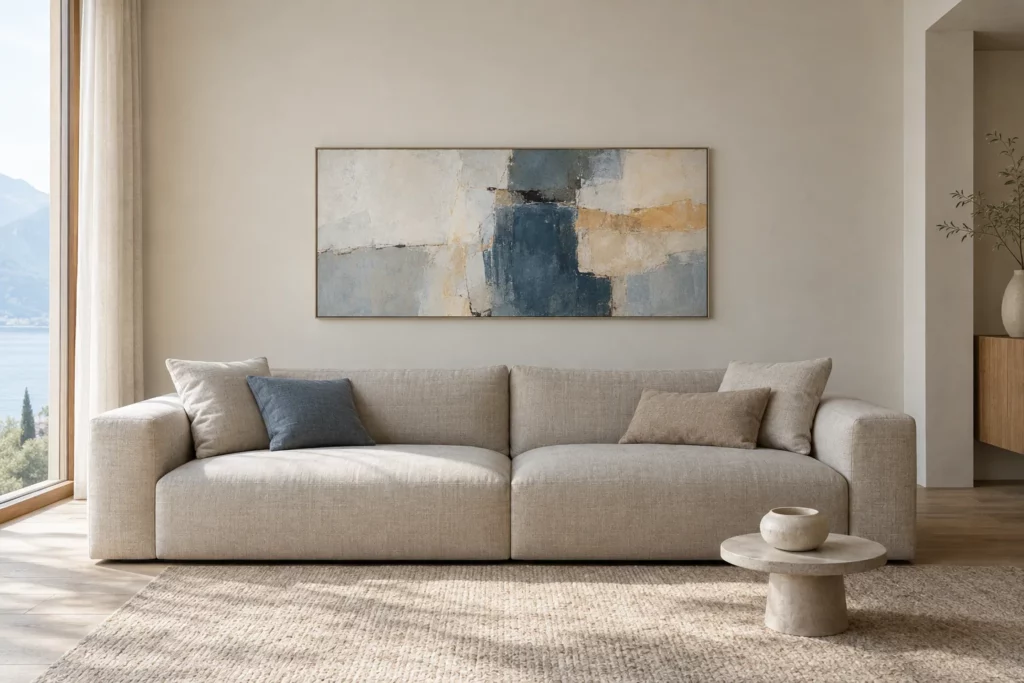
The right art size above sofa level depends on the sofa’s width, the available wall space and the effect you want—not a fixed percentage rule. Start by comparing specific artwork widths with your sofa, then test the full outline, including both height and width, using a paper template or a photomontage made to scale.
You already know how wide your sofa is. But that measurement alone cannot tell you whether an original artwork measuring 100, 120 or 155 cm wide will look right above it. The amount of clear wall space above the backrest matters just as much.
The calculations below turn sofa measurements into straightforward size comparisons. Four original works from Kunstwarenhaus then show why you should always assess width and height together.
Choosing art for above the sofa: measure the width and clear wall space first
Measure not just the furniture, but also the wall space you can actually use. Even a wide wall may be restricted by a window, shelving or a light fitting. Record the following measurements on a simple sketch.
- Overall sofa width: from the outer left edge to the outer right edge, including the armrests.
- Top of the backrest: use this as the reference point for the clear space above.
- Side boundaries: wall edges, windows or neighbouring furniture, for example.
- Clear height: from the backrest to the ceiling or any feature that limits the space.
With a corner sofa, deliberately choose the section above which the artwork will hang as your reference width. Note which section you measured. This avoids accidentally comparing the artwork’s width with the full span of the corner sofa later.
All artwork dimensions in this article are given as height × width. When planning, use the complete outer outline: if you are adding a frame, also account for its confirmed external dimensions. The stated artwork dimensions alone do not replace this check.
100, 120 or 155 cm: compare artwork widths above the same sofa
The width ratio makes sizes easier to compare: artwork width ÷ sofa width × 100 = percentage. For example, a 120 cm-wide artwork above a 200 cm-wide sofa gives 120 ÷ 200 × 100 = 60%. This describes a proportion, not a design recommendation.
| Artwork width | Proportion of a 200 cm sofa | Proportion of a 240 cm sofa | Space remaining on each side above a 200 cm sofa |
|---|---|---|---|
| 100 cm | 50% | around 42% | 50 cm |
| 120 cm | 60% | 50% | 40 cm |
| 155 cm | 77.5% | around 65% | 22.5 cm |
The space remaining on each side assumes the artwork is centred and is calculated as (sofa width − artwork width) ÷ 2. This is the horizontal difference between the artwork’s edge and the sofa’s outer edge, not the distance to a wall. Above a 200 cm sofa, the narrower option leaves noticeably more breathing room; the wider one reaches closer to the sides of the sofa. Above a 240 cm sofa, those proportions change appreciably.
These figures are examples for comparison, not ideal minimum or maximum dimensions. A two-thirds rule would likewise be no more than a design rule of thumb. What matters is which option looks right on your wall—and whether its height works too.
Urban Prelude by Carl Smith measures 80 × 100 cm (height × width). This original provides the narrowest width comparison in the table. Use it to assess whether you prefer the extra space on either side.
I love you by Cynthia Coulombe-Bégin measures 62 × 120 cm (height × width). It is wider yet shorter than the previous example. Greater width does not automatically mean taking up more vertical space.
Almost the same width, noticeably different heights
Earth Spiegelungen by Evelyn Dönicke measures 65 × 155 cm (height × width). Its width matches the widest example in the table, while its outline takes up comparatively little vertical space.
Hallows by Amber Goldhammer measures 92 × 152 cm (height × width). Despite being almost the same width, this original needs noticeably more room above.
The two works differ by just 3 cm in width, but by 27 cm in height. For your first comparison, align their paper outlines along the same bottom edge. You will immediately see how much further one extends upwards. Then assess the position you prefer for each outline within your available wall space.
Test your preferred size at home: paper outlines, a seated check and room photos
- Prepare paper outlines at the artwork’s actual size. Label each with its height and width so you can clearly distinguish the options.
- Temporarily position one outline at a time on the wall. Use only a fixing suitable for your wall surface that can be removed without leaving residue.
- Compare the options from the room entrance and your usual viewing positions. Assess both the space on either side and the area remaining above.
- Sit on the sofa. Check whether the planned position behind the backrest seems practical for everyday use, including when you lean back as usual.
- Photograph the options from the same position wherever possible. This makes it easier to compare the differences later.
A template shows how much space an artwork needs, but not yet how its imagery will look. On each artwork page, you can use the sofa icon to upload a photo of your room and place the work in it. Use this preview for an initial visual comparison; do not assume that it automatically displays the artwork to scale.
For a comparison made to scale, Kunstwarenhaus offers a free photomontage service: you send a photo of your room, and the gallery adds your selected works at the appropriate scale. Have your sofa and wall measurements ready. The paper test and the view of the actual original then complement each other.
Use two tested sizes to find the right original
After comparing, keep two size options rather than settling on a supposedly perfect measurement. Then look for a work whose imagery and actual dimensions both suit the space. Kunstwarenhaus carries original artworks, not posters or mass-produced reproductions.
- Noted the height and width of two outlines that work well?
- Allowed for side boundaries and clear height?
- Included any frame in your planning?
- Checked the effect from several viewpoints and while seated?
- Gathered your room photo, measurements and selected works for a consultation?
Now compare original works in the catalogue. If two options seem equally suitable, free personal art advice can help with the next step. You can also visit the showroom at Neumarkt 6 in Zürich to assess the works in person. Before making a visit to see specific pieces, check whether your selected works are on display there.
Finding the right artwork size takes measuring, comparing and testing. The width ratio offers a starting point; only the complete outline shows whether the work fits your wall. With two tested options and a photomontage made to scale, you can narrow down your choice of an original. Read more: Art in the living room: 7 decisions before buying.
Discover original works and compare their height and width with the outlines you have tested.