

Buying art for beginners: your first original artwork
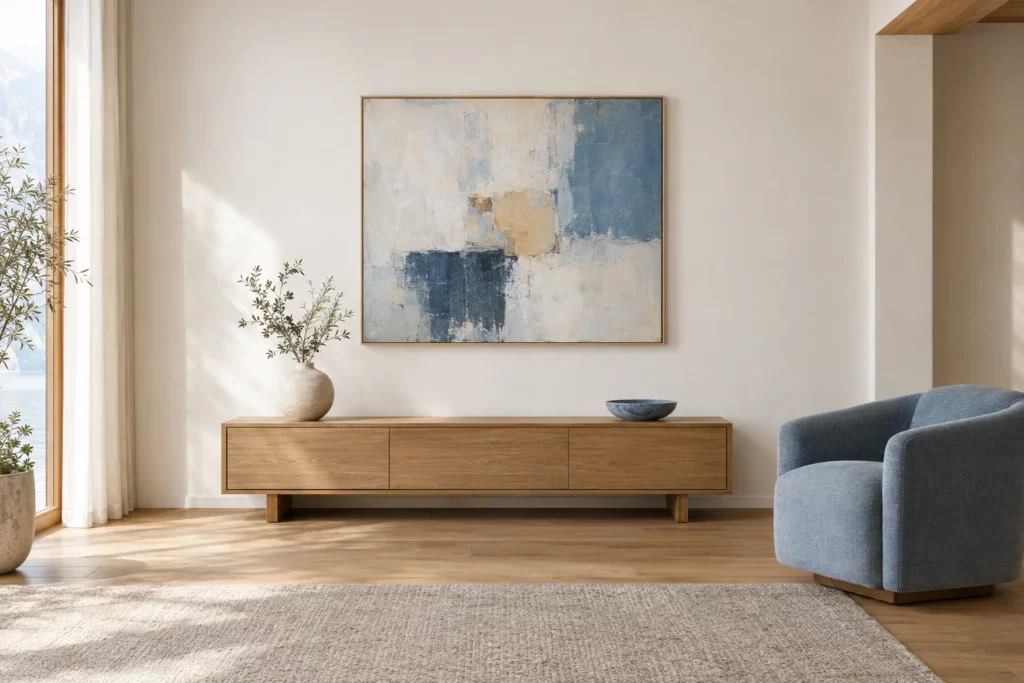
Buying art for beginners starts with three things: your personal spending limit, the space available and your reason for buying. Next, compare a small selection of original artworks using the same questions, then view your favourites in person. Buy when your interest in the work lasts and you have confirmed the dimensions, total costs and answers to any outstanding questions.
You do not need specialist vocabulary or plans for a collection to buy your first original artwork. A manageable process that brings together personal preferences and practical questions is more useful. You do not need to explain why everyone should like a work, only why you would like to live with it.
This guide takes you from a short personal brief through a shortlist of three works to a viewing in Zurich. A photomontage or trial hanging can then help you address specific doubts. The aim is not to decide as quickly as possible, but to make a choice for reasons you understand.
Buying art for beginners starts with three details
Before you start saving or comparing artworks, write down the criteria for your decision. A few lines on your phone or on paper are enough. This gives you a point of reference later if a particularly appealing work changes your original ideas.
- Budget: “For this purchase, I want to spend no more than CHF … in total.” This is your personal limit, not what you imagine a suitable starting price should be.
- Space: “The usable wall space is … cm wide and … cm high.” Measure the area that is actually free and note nearby furniture, doors or other restrictions.
- Expectations: “I want to buy an original artwork because …” Complete the sentence in your own words, perhaps with a subject that interests you or a wish to create a personal focal point in the room.
Set a budget you are comfortable spending on the work without assuming you will sell it later. Potential investment value is not a decision criterion for this brief. You can also spend less than planned; your limit is not a target.
Allow for possible additional costs before deciding how much you can spend on the artwork itself. Courier delivery within Switzerland starts at CHF 35. Ask for the actual delivery cost and whether your preferred finish or hanging arrangements involve any further charges. Do not automatically budget for the starting price alone.
Add a room photo and a short list of materials to your brief, such as oak, grey fabric and pale stone. These are starting points for a conversation, not a requirement for the artwork to repeat every colour in the room.
Choose three works and compare them using the same questions
For your first closer comparison, try limiting your shortlist to three works. This is a practical aid, not a fixed rule. Include only works you would want to explore regardless of their price. The examples below show what a factual comparison can look like; they are neither a ranking nor a guarantee of current availability.
| Artwork | Artist | Medium | Height × width | Price |
|---|---|---|---|---|
| No Suffer | Valerie Etitinwo | Acrylic | 80 × 100 cm | CHF 1,050 |
| Three Cameras | Johnny Taylor | Mixed media on canvas | 90 × 90 cm | CHF 1,000 |
| Sunrise | Katharina Husslein | Oil on canvas | 80 × 100 cm | CHF 1,700 |
“No Suffer” and “Sunrise” have the same dimensions but differ in medium and price. “Three Cameras” is square. None of this establishes a ranking of quality or explains the prices. For now, the details simply help you distinguish between format, stated materials and budget.
- Interest: What exactly would I like to spend more time looking at in this work, and does my interest go beyond a colour that suits the room?
- Space: Does the stated size fit the area I have measured? What am I still unsure about when it comes to placement?
- Budget: Will the artwork price, together with any additional costs still to be confirmed, stay within my limit?
Write down one positive reason and one open question for each work. For example: “I would like to look more closely at the surface; I am still unsure how it will look beside the wooden cabinet.” This gives your viewing a purpose rather than simply producing a list of favourites. A suitable price alone is not a reason to buy.
Bring a room photo, measurements and specific questions to your viewing
The Kunstwarenhaus gallery and showroom are at Neumarkt 6, 8001 Zürich. Almost all works on the website are displayed in the 160 m² showroom. Even so, check in advance that your chosen works can be viewed there. You can send the artwork titles or SKUs to info@kunstwarenhaus.ch or ask by phone on +41 44 501 88 18.
Bring your short brief, room photo, wall measurements and notes on the three works. If you would like help choosing, share your budget limit too. This makes the conversation more focused: it becomes about your actual decision rather than general recommendations.
- First, look at the whole work from a little distance. Ask yourself whether your initial interest holds when you see the original.
- Next, look closely at the surface without touching the work. Note anything you notice that was not apparent on screen.
- Ask about the stated medium, dimensions and anything else that remains unclear about the work.
- Return to your comparison notes: which positive reason still holds, and which question has been answered?
The free personal art consultation is optional support. You can ask for help without handing over your decision. Feel free to express a reservation such as “I am interested in the work, but I am still unsure about the size.” This gives you a useful next step to explore.
Address specific doubts: photomontage or trial hanging?
Not every doubt calls for a fresh search. First, identify what is missing: a sense of scale, the right position or an impression of the original in your own room. Then choose the help that addresses that particular question.
| Open question | Suitable next step |
|---|---|
| How will this size look on my wall? | Send a room photo for the free photomontage. The gallery will add your selected works to scale. |
| Where could I place the work? | Use the sofa icon on the artwork page to upload your own room photo and position the work in it. |
| I would like to assess the original in my room. | Ask about the free trial hanging and confirm the arrangements directly with the gallery. |
Where possible, address one question at a time. With a photomontage, you might start with placement; during a trial hanging, you can return to your questions about colours, surface and the materials already in the room. Write down what you want to look for beforehand, rather than simply hoping it will feel right.
A digital room view is a guide, not a substitute for seeing the original. For a trial hanging, ask about the arrangements, duration and any transport costs rather than assuming the terms.
Make a decision rather than search endlessly: your buying checklist
You have explored your shortlist sufficiently when the questions that matter to you have been answered. You do not need to rule out liking another work at some point in the future. What matters is whether you are choosing this original for clear reasons of your own.
- Am I interested in the work itself, not just its price or a colour that suits the room?
- Do the artwork price and confirmed additional costs stay within my personal budget?
- Have I checked the dimensions against the intended space?
- Have my outstanding questions about the work and the purchase been answered?
- After viewing it, do I still want to make a considered choice to buy this work?
A no does not mean you have to start again. Return to the relevant point: check the measurements, ask about costs or discuss your impressions in a consultation. If personal interest is missing, however, you can remove a work from the shortlist even if it would be a good practical fit.
Once you have decided, credit card and bank transfer are the available payment options. Before buying, reconfirm the current price and availability of your chosen work.
A good first art purchase does not require a complete overview of the market. Personal criteria, a few thoughtfully compared works and a prepared viewing provide a useful starting point. Use a photomontage or trial hanging to address specific remaining questions, and take your time if an important point is still unresolved. Read more: Art for living room walls: 7 decisions before buying.
Start with a small selection from the catalogue of original artworks and note one reason to buy and one open question for each favourite.