

Original art vs prints: what makes a one-off artwork special?
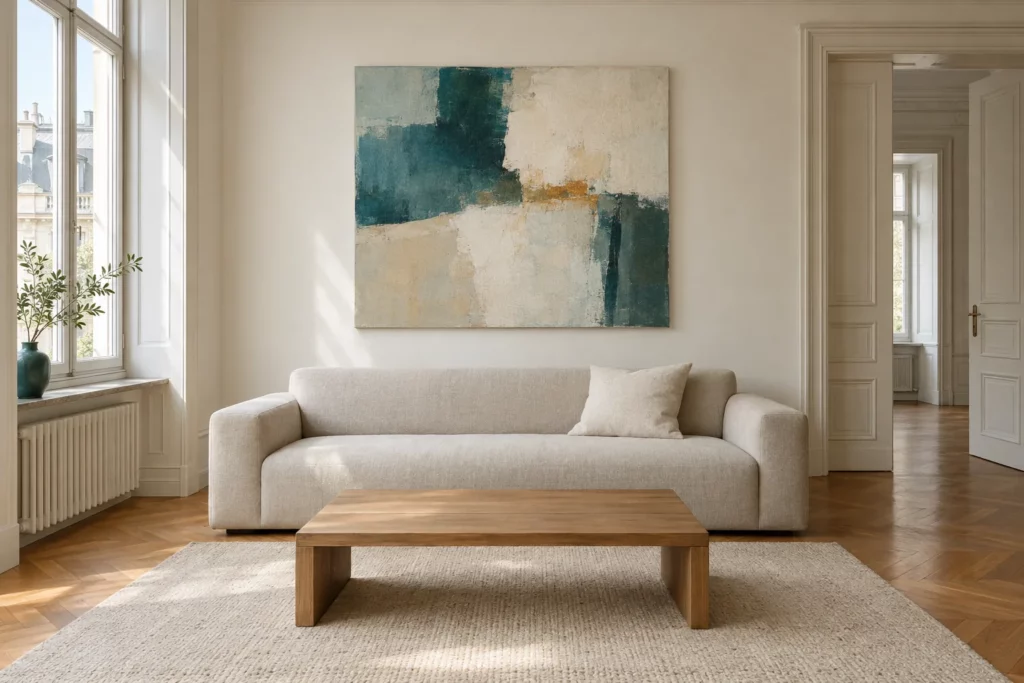
When weighing up original art vs prints, an original is worth choosing if it is not just the image that matters to you, but that particular artwork. You can explore this through your response to the work, its physical qualities, its dimensions and its place in your everyday life—not simply the label ‘original’.
When comparing original art vs prints, you may already have a work in mind but wonder how much its one-off nature really matters to you. A useful question is: which qualities would you miss if you chose a reproduction? There is no single answer that applies to everyone.
Here, we compare a one-off original artwork with a reproduced image. This is not a classification of all printmaking techniques; original fine art prints are outside the scope of this comparison. Three documented works from Kunstwarenhaus make the decision more tangible, without presenting either buying option as inherently better.
Original art vs prints: the image or the individual work?
Start with what you want, rather than the price. Are you looking for a particular subject for an empty wall? Or are you drawn to a specific artwork that you would not want to replace with another image? Both are reasonable starting points. What matters is recognising your own priority before the label ‘original’ becomes a reason to buy.
Put these three priorities in order and add a short reason for each. ‘I am mainly looking for a particular subject’ is just as useful as ‘I am interested in this specific work’. If the appeal of owning a one-off still feels abstract, that is fine: the next steps will help you connect it to things you can actually observe.
Material and size: comparing three original artworks
These three works offer different starting points for your selection. Read their details without ranking them: acrylic, oil and mixed media are not grades of quality here. Nor does the price tell you which work will interest you most. All dimensions in the table are given as height × width.
| Artwork | Artist | Medium | Height × width | Price |
|---|---|---|---|---|
| Lebenslinien | Soraya Louyeh | Acrylic on canvas | 50 × 100 cm | CHF 1,400 |
| Sunrise | Katharina Husslein | Oil on canvas | 80 × 100 cm | CHF 1,700 |
| Three Cameras | Johnny Taylor | Mixed media on canvas | 90 × 90 cm | CHF 1,000 |
‘Lebenslinien’ and ‘Sunrise’ are both 100 cm wide, but differ considerably in height. At 90 × 90 cm, ‘Three Cameras’ provides a square point of comparison. First, ask yourself which proportions appeal to you. Then choose a medium whose physical qualities you would like to examine more closely.
Write down an open question for each work rather than making a quick judgement: ‘How does this size feel close up?’ or ‘What can I actually see on the surface?’ The medium alone does not establish whether there are particular brushmarks or a raised texture.
Explore what matters to you: close up and from across the room
An image helps you draw up a shortlist. To make your decision, it is also worth taking time to look carefully at the actual work. This is not about finding as many technical terms as possible. Instead, describe precisely what holds your attention and what interests you less as you spend more time looking.
- Start with the whole work. Choose a viewing distance that the room allows and that roughly matches how you would see it in its intended setting.
- Move closer. Describe only visible features, such as areas of colour, transitions or differences in the surface, provided you can actually see them.
- Step back again. Which observations still matter to your overall impression?
- Then look at a second work in the same way. Compare your notes without ranking the works by medium or price.
Afterwards, complete two sentences: ‘What draws me to this work is …’ and ‘Even without the label original, I would be interested in …’. If all that comes to mind is its status as a one-off, that is allowed to matter to you. But let it be a conscious reason for your decision—not a substitute for qualities you have not yet examined.
If you are also considering a specific reproduction, note what appeals to you about that too. Compare your actual options, rather than a carefully examined original with an imagined alternative.
Does this particular one-off artwork suit your wall?
Measure the available wall width and height in centimetres. Also note any furniture, doors or other features that limit the space. Check not just whether the work physically fits, but whether you like its position in everyday use: from the sofa, from your desk or as you enter the room.
Comparing the three sizes makes this practical. Although they have the same width, ‘Sunrise’, at 80 cm high, takes up more wall height than ‘Lebenslinien’, at 50 cm. ‘Three Cameras’ is slightly narrower at 90 cm, but also 90 cm high. Knowing that your wall can accommodate a width of 100 cm does not tell you which height will work.
You can send Kunstwarenhaus a photo of your room for a free, to-scale photomontage. If possible, photograph the wall with the surrounding furniture and have your measurements ready to discuss. The gallery inserts your selected works to scale. Alternatively, use the sofa icon on any artwork page to upload your own room photo and place the work in it.
Use the room view to answer ‘Do these dimensions work here?’ and an in-person viewing to answer ‘Does this particular work interest me?’ A photomontage cannot replace looking at the actual surface.
Set a budget without automatically favouring original art
Set a personal spending limit before making your final choice. The three prices listed are for specific works, not a general market price range: ‘Three Cameras’ costs CHF 1,000, ‘Lebenslinien’ CHF 1,400 and ‘Sunrise’ CHF 1,700. These prices do not establish a ranking of artistic quality or how much you will value the works over time.
For example, with a self-imposed limit of CHF 1,400, ‘Three Cameras’ and ‘Lebenslinien’ fall within your artwork budget, while ‘Sunrise’ exceeds it. This is a budget decision, not a judgement on the works. If you are weighing up an original and a reproduction, use an actual offer for the reproduction too, rather than an assumed price.
Consider any price difference neutrally: which qualities of each option make it worth its price to you? Give two specific reasons for your preferred choice. These might be suitable dimensions, a physical quality you have observed or the desire to own that particular one-off piece. Neither option has to be more compelling simply because of its price.
Compare works in Zurich, then explore originals with a clearer focus
The Kunstwarenhaus gallery and showroom are at Neumarkt 6, 8001 Zürich, in the Niederdorf. Almost all works on the website are displayed in the 160 m² showroom. This does not mean that every work mentioned here will be there when you visit. If you are coming to see particular favourites, ask about them beforehand.
- Note two or three favourites by title or SKU.
- Have your wall measurements, a room photo and your budget limit ready.
- Rank your priorities: subject, material and the individual artwork.
- Bring a specific question about what to look for in each favourite.
- After viewing, record which work you prefer and why.
Discuss any questions about physical qualities, dimensions and choosing a work during a free personal art consultation. This can also take place at your home or office on request. A useful starting question is: ‘What should I compare in these works to understand my own preference more clearly?’
Kunstwarenhaus sells only original artworks, not posters, prints or duplicates. If your assessment points towards an individual work, you can discover original artworks in the catalogue and continue choosing with your newly clarified criteria.
A one-off artwork does not have to be the right choice for everyone. What matters is whether this particular work offers something you consciously want to own and see every day. When your observations, wall space and budget align, your purchase rests on more than a label. Further reading: Art for living room walls: 7 decisions before buying, Buying art for beginners: your first original artwork.
Use your priorities to guide your selection and find original artworks you would like to explore more closely.